

 translate(0, -860.8406647116325)' d='M154.804 384.176l412.234 406.975-48.149 48.772-485.070-478.883 484.522-500.59 49.245 47.664-394.447 407.529h1094.134v68.535h-1112.468z' /></svg>)
 translate(0, -860.8406647116325)' d='M1146.737 384.176l-412.234 406.975 48.149 48.772 485.070-478.883-484.522-500.59-49.245 47.664 394.447 407.529h-1094.134v68.535h1112.468z' /></svg>)
全球经济状况调研:2016年第一季度
With emerging economies continuing to struggle with low commodity prices, speculation intensified in Q1 that the global economy might even be heading for recession. Efforts by the European Central Bank (ECB) and the Bank of Japan to increase monetary stimulus yielded unconvincing results, while the prospect looms of further rate hikes by the US Fed.
In Q1 businesses were less optimistic about their prospects than at any other time in the past four years. Almost half of the firms surveyed said that they were more pessimistic about their prospects than they were three months earlier. Less than one-quarter had become more optimistic.
Employment freezing?
The fall in confidence did not trigger a drop in the capital expenditure and employment indices, but more than half of firms are still either cutting or freezing employment; only 14%, meanwhile, are increasing investment in staff, and as many as 42% of firms are cutting back on investment.
What does this research tell me that I didn’t know before?
Large firms are more likely to trade across borders, so are reporting declining incomes and the negative effects of exchange-rate movements more than SMEs. More of these firms are also cutting capital expenditure and employment.
Rising costs
Rising costs and foreign-exchange movements remain an important problems facing businesses, but the number of firms that are being hurt by these two factors declined in Q1 2016. The drop in commodity prices has obviously reduced many of the costs facing businesses: 49% of businesses said that last quarter they saw an opportunity to cut costs.
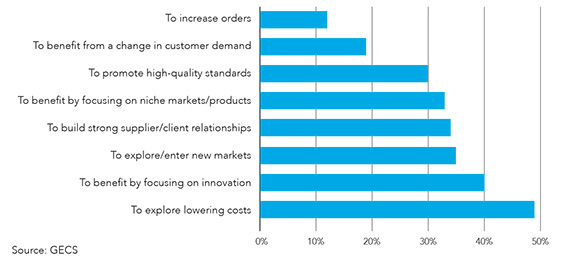
Graph showing business opportunities resulting from changes in global economy in Q1 2016. Lowering costs is the largest opportunity.

手机扫描二维码,关注ACCA中国官方微信。
